



It’s no secret that one of America’s favorite pastimes is fishing. Well, for some it’s a pastime, for others, it’s a way of life. And it’s easy to see why. Some of the most productive fisheries on the planet are right here. Still, when faced with that many fantastic choices, anglers wrestle with the same question: Where to begin?
To answer this question, FishingBooker went on a quest to find out which are the best US fishing states – for the fourth year in a row. And look out, there are some real changes compared to last year!
We made use of our own data and paired that information with other public fishing-related sources. This helped us better understand which states not only have the most prolific angling but also support and develop their fisheries. In this article, we’ll explain the methodology behind the research and rank the US’s states according to their fishing potential. Let’s get started!
Key Takeaways
Before we get into the nitty-gritty details, let’s go through some key takeaways from our research:
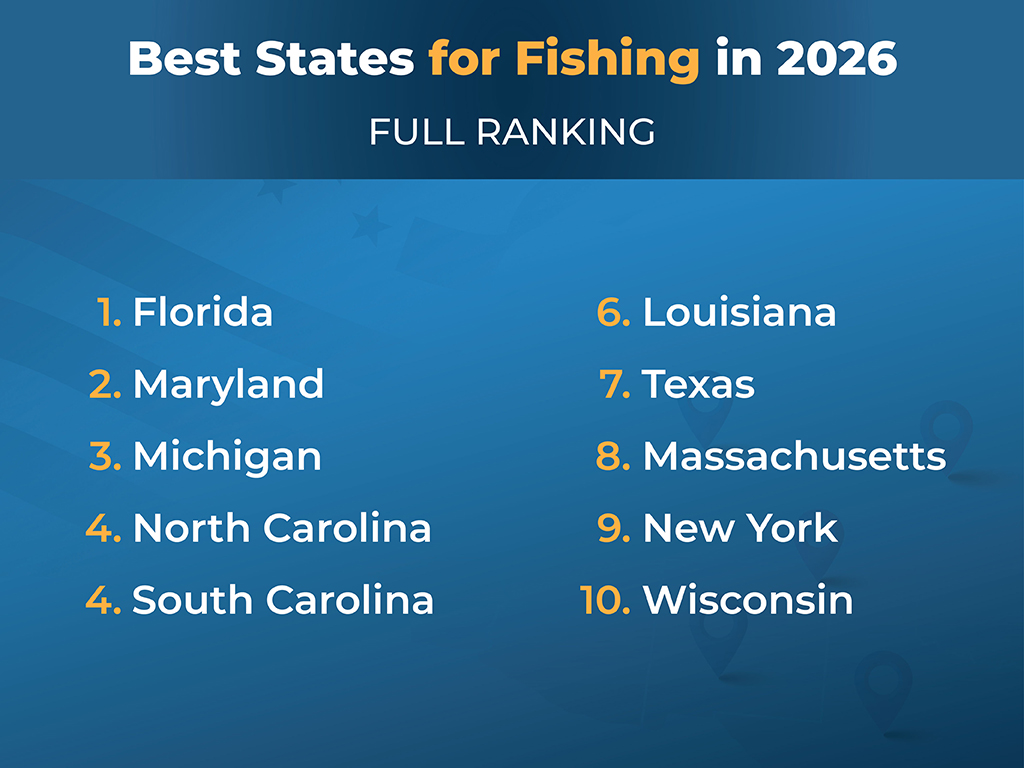
- Florida takes the top spot in 2026, climbing from 2nd place last year and reclaiming its position as the best fishing state in the US.
- Maryland is the biggest winner at the top of the table, jumping from 7th in 2025 (and 11th in 2024) all the way up to 2nd place.
- The 2026 top 5 looks very different than in previous years, with North Carolina and South Carolina surging into shared 4th place and Michigan rising from 4th to 3rd.
- There are 3 more newcomers in the top 10 compared to 2025:
- Texas
- Massachusetts
- New York
- The states with the biggest ranking gains compared to 2025 are:
- Texas (up 23 spots, from 30th to 7th)
- Massachusetts (up 13 spots, from 21st to 8th)
- New York (up 14 spots, from 23rd to 9th)
- Iowa (up 23 spots, from 46th to 23rd)
- The states with the biggest ranking drops compared to 2025 are:
- Alaska (down 14 spots, from 1st to 15th)
- Oklahoma (down 19 spots, from 13th to 32nd)
- Illinois (down 12 spots, from 15th to 27th)
- The top 10 contains:
- 6 Atlantic states
- 2 Great Lakes states
- 3 Gulf Coast states
- Coastal access still plays a major role: of the top 25 states, just 3 are landlocked*, while landlocked states make up the majority of the bottom 25.
(*Great Lakes states are counted as not landlocked.) - California continues to underperform, ranking just 40th despite having over 800 miles of coastline and access to world-class freshwater and saltwater fisheries.
- Texas makes a dramatic comeback, climbing to 7th place after ranking just 30th last year — a result more in line with its reputation as a premier fishing destination with Gulf Coast access, major freshwater lakes, and a packed tournament calendar.
Methodology
Our extensive research of the US’s fishing opportunities was based on 17 different criteria. Out of these, five criteria were based on FishingBooker’s internal data from hundreds of thousands of fishing trips, reviews, and reports, as well as our industry research. The remaining 12 criteria come from publicly available data sources.
Once we established the criteria, we grouped them into four separate categories – Anglers’ Interest, Facilities, Financial, and Geography.
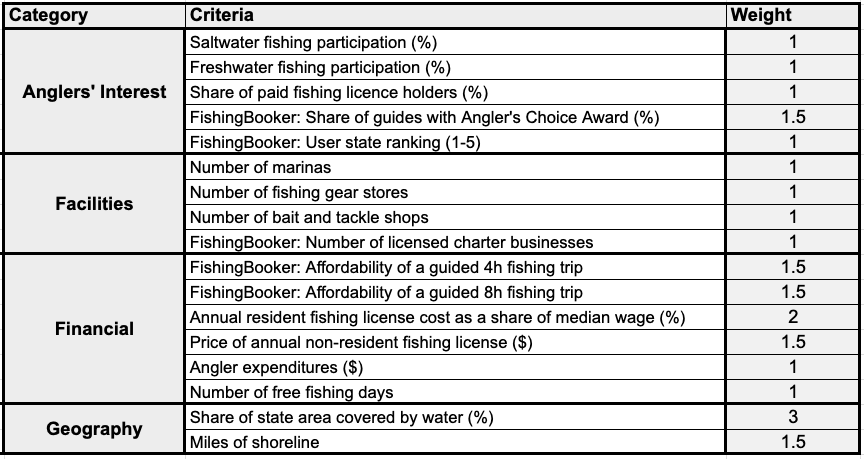
Using the accumulated data, each of the states received a score of between 1 and 10 for each criterion. Some of the criteria were considered of special significance and were given additional weight in the calculations. The maximum possible score a state could get was 225 points. Once the scores were calculated and weighted, we summed them up. Then, we got the ultimate list of US states with their fishing potential ranked from best to worst.
Now we’ll cover the top 10 fishing states on the list. First, we’ll highlight what makes each state great. Then, we’ll explain the research categories where they stand out. Without further ado, here they are – the best US states to fish in 2026!
Top 10 Fishing States in the US
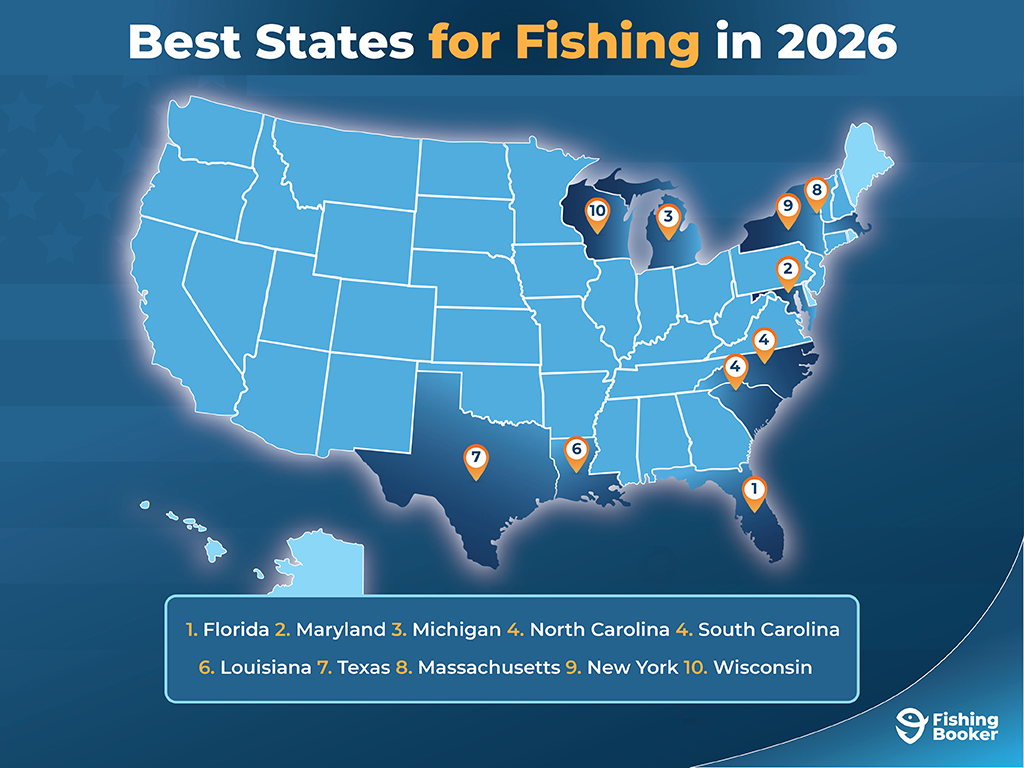
| Position | State | Points |
| 1 | Florida | 123 |
| 2 | Maryland | 122.5 |
| 3 | Michigan | 119.5 |
| 4 | North Carolina | 115.5 |
| South Carolina | ||
| 6 | Louisiana | 113 |
| 7 | Texas | 112 |
| 8 | Massachusetts | 111.5 |
| 9 | New York | 110 |
| 10 | Wisconsin | 109 |
1. Florida
123 points
After finishing second last year, Florida takes the top spot in 2026. As a result, it cements its status as the undisputed saltwater fishing capital of the US. With the Atlantic Ocean on one side and the Gulf of Mexico on the other, the Sunshine State offers over 8,400 miles of coastline. Moreover, its warm, clear waters hold an unmatched variety of game fish.
Florida’s 2026 rise is driven by exceptionally strong angler interest. In fact, the state earned one of the highest Anglers’ Interest scores in the country (46 out of 55). This reflects its year-round demand and global reputation. Additionally, solid Facilities results supported its climb. At the same time, its long coastline and diverse fisheries boosted its Geography score.

However, financial accessibility was Florida’s weakest point. Higher trip costs and overall expenses lowered its Financial score. As a result, the state didn’t dominate every category. Even so, Florida’s popularity, accessibility, and fishing diversity more than made up for it. Ultimately, that strength secured the number-one ranking.
So, if you’re looking for saltwater fishing on the US mainland, Florida sets the benchmark. For example, anglers can target inshore favorites like Redfish, Tarpon, and Snook. Meanwhile, offshore waters hold King Mackerel, Grouper, Snapper, and Sailfish. All in all, Florida delivers unforgettable action year-round.
2. Maryland
122.5 points
Few states benefit from a natural resource as impactful as the Chesapeake Bay. In 2026, it played a key role in Maryland’s rise. As a result, the state climbed all the way to 2nd place. With roughly a fifth of the state covered by water, Maryland offers outstanding opportunities for both saltwater and freshwater anglers.
Maryland posted a strong 37.5 out of 55 in Anglers’ Interest, reflecting consistent demand and widespread appeal among anglers. Its Geography score of 22.5 points highlights the state’s exceptional access to bays, rivers, tidal systems, and nearshore Atlantic waters. A solid showing in the Financial category (46.5 out of 85) also played a key role in Maryland’s rise. It helped it stand out as a comparatively cost-balanced destination.

However, Maryland fell short in Facilities. It scored just 16 out of 40. As a result, it trailed several top contenders and couldn’t challenge for the number-one spot. Even so, strong angler interest helped to keep the gap modest. Additionally, favorable geography and solid financial accessibility strengthened its position. Together, these factors secured Maryland 2nd place in 2026.
Maryland is one of the top destinations for Striped Bass fishing on the East Coast. In addition, anglers can target Black Seabass, Flounder, Tautog, Mackerel, Cobia, and Black Drum. Offshore, Tuna and White Marlin are the main prize. Meanwhile, the state’s rivers, lakes, and creeks hold Catfish, Perch, and Bass.
3. Michigan
119.5 points
Freshwater fishing remains Michigan’s great strength. In 2026, it helped the state climb to 3rd place overall. With access to four of the five Great Lakes, Michigan stands out nationwide. As a result, it remains the epicenter of freshwater fishing in the US.
This advantage is clear in the numbers. Michigan earned the highest Geography score in the rankings, with 34.5 points. This is thanks to its unmatched access to massive lakes, inland waters, and connected rivers. In fact, more than 40% of the state is covered by water, spanning over 40,000 square miles. As a result, anglers can fish the Great Lakes, explore more than 11,000 inland lakes, or choose from around 3,000 rivers.
Infrastructure and affordability further strengthened Michigan’s performance. The state earned 18 out of 40 points in Facilities. This reflects solid access and reliable on-the-water services. Meanwhile, a 44 out of 85 Financial score kept it competitive, particularly considering rising costs elsewhere. Anglers’ Interest was more modest at 23 out of 55. This suggests Michigan’s fishing quality outshines its national hype, especially compared to coastal states.
Even so, Michigan’s scale and freshwater variety are hard to match. From Walleye, Trout, and Salmon to Bass, Northern Pike, and Muskellunge, the options are extensive. Additionally, the state is a top destination for ice fishing. Taken together, these strengths explain Michigan’s high spot in the 2026 rankings.
4. North Carolina
115.5 points
North Carolina delivers one of the biggest comebacks in the 2026 rankings. After finishing 17th last year, the Tar Heel State made a huge jump. In 2026, it surged to 4th place. This rise was fueled by growing angler demand and steady results across several categories.
Most importantly, angler interest drove the leap. North Carolina earned 47 out of 55 points in Anglers’ Interest – the highest score in the category. This reflects its strong appeal in both saltwater and freshwater fisheries. In addition, solid infrastructure supported the climb. The state scored 24 out of 40 in Facilities, backed by a thriving charter scene and broad public access.

Meanwhile, North Carolina remained competitive on affordability, earning 31 out of 85 points in Financial. That score kept it in line with other top-ranking states. However, Geography was its weakest category at just 13.5 points. This reflects its smaller water footprint compared to the very top contenders, which boast broader coverage or standout natural features.
Even so, North Carolina’s breadth of fishing opportunities more than made up for that limitation. Along the coast, anglers can target Redfish, Flounder, King Mackerel, Spanish Mackerel, and Tuna. Offshore, on the other hand, waters are known for billfish action. Inland, the state offers excellent Bass, Catfish, and Trout fishing – a combination that fueled its dramatic rise back into the top tier in 2026.
4. South Carolina
115.5 points
South Carolina continues its steady climb in the rankings, finishing 4th overall in 2026 after placing 11th last year. Rather than relying on a single standout factor, the Palmetto State’s strong showing was built on broad appeal and reliable infrastructure, especially along its productive coastline.
Interest from anglers remained one of South Carolina’s biggest strengths. The state earned 46 out of 55 points in Anglers’ Interest, signaling sustained popularity for its inshore and nearshore fisheries. That demand is met by capable, if not dominant, infrastructure, with 22 out of 40 points in Facilities supporting a busy charter scene and widespread coastal access.

Cost and physical layout played a more limited role. South Carolina posted 38.5 out of 85 points in the Financial category, placing it closer to the middle of the field in terms of affordability. Its Geography score of 9 points reflects a smaller footprint and fewer large-scale water systems compared to other states at the top of the rankings.
What ultimately keeps South Carolina competitive is the quality of its fishing. Shallow-water action for Redfish, Spotted Seatrout, and Flounder defines much of the coast, while nearshore and offshore waters produce King Mackerel, Spanish Mackerel, Snapper, and Billfish.
6. Louisiana
113 points
Louisiana moves back into the top 10 in 2026, finishing 6th overall after ranking 13th last year. The state’s return was fueled by its natural advantages and strong value for anglers, particularly in its extensive inshore waters.
Geography played a major role in Louisiana’s performance. The state earned 22.5 points in this category, reflecting its vast network of marshes, bayous, deltas, and nearshore Gulf waters that support one of the most productive inshore fisheries in the country. And lets not forget the mighty Mississippi River. Louisiana also delivered a strong showing in Financial, scoring 45 out of 85 points, which helped position it as one of the more cost-effective options among high-ranking states.
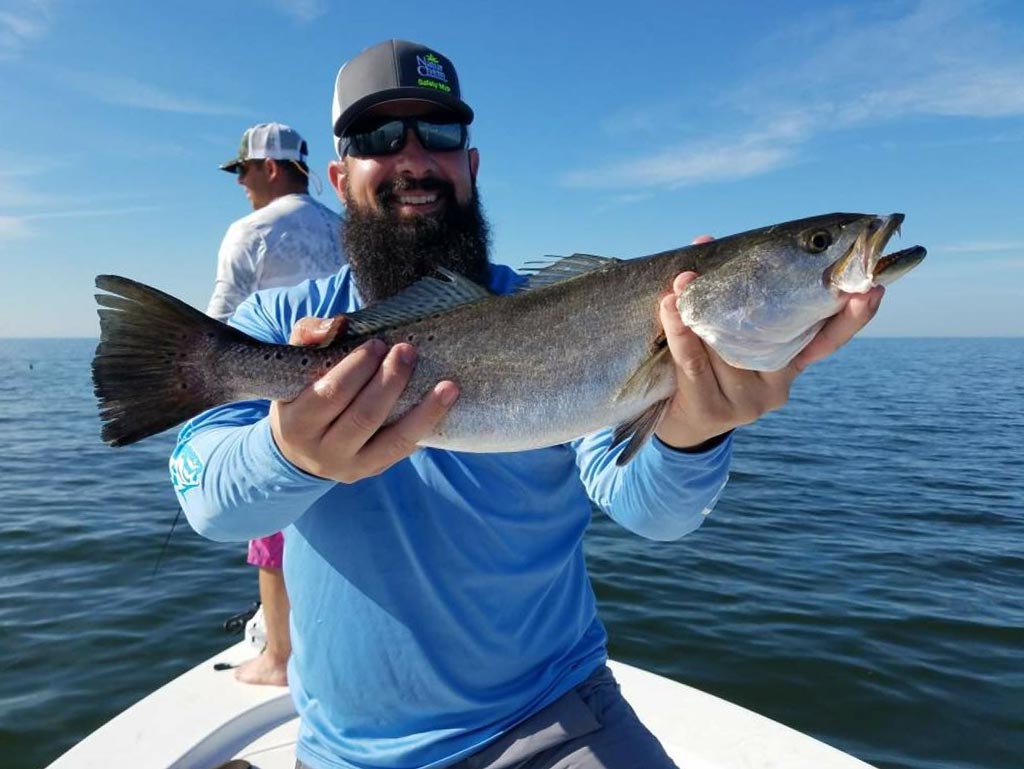
Angler demand remained steady rather than explosive, with Louisiana posting 33.5 out of 55 points in Anglers’ Interest. Facilities proved to be the main constraint, where the state scored 12 out of 40 points, trailing several other top-10 contenders in terms of infrastructure density and charter availability.
Even so, Louisiana’s fishing quality continues to do the heavy lifting. The state is renowned for its Redfish and Speckled Trout fisheries, particularly in the Mississippi River Delta and coastal marshes, while nearshore waters also produce Flounder, Sheepshead, and Black Drum.
7. Texas
112 points
Texas delivers one of the most dramatic reversals in the 2026 rankings. After finishing just 30th last year, the Lone Star State surged to 7th place, driven primarily by elite infrastructure and strong, broad-based angler demand.
That strength is most visible in Facilities, where Texas posted 29 out of 40 points, the highest score in the country. A dense network of marinas, ramps, and charter operations along the Gulf Coast, paired with extensive inland access, gave the state a clear edge. Angler demand followed closely behind, with Texas earning 38.5 out of 55 points in Anglers’ Interest, reflecting its appeal across both saltwater and freshwater fisheries.

Other categories proved more limiting. Texas scored 37 out of 85 in the Financial category, indicating higher costs compared to many other top-10 states, while Geography lagged behind with 7.5 points, as the state lacks the concentrated water coverage or uniquely dominant systems seen in higher-ranked contenders.
Even so, Texas offers exceptional fishing variety. Coastal anglers can target Redfish, Speckled Trout, Flounder, and King Mackerel, while offshore waters produce Snapper, Tuna, and billfish. Inland, the state’s lakes and reservoirs are famous for trophy Largemouth Bass fishing – a combination that powered Texas’ return to the top tier in 2026.
8. Massachusetts
111.5 points
Massachusetts makes a quiet but significant leap into the top 10 in 2026, climbing to 8th place after sitting well outside this group in previous years. The state’s rise wasn’t driven by a single breakout metric, but by steady improvement across multiple areas, particularly when it comes to value and access.
One of Massachusetts’ biggest advantages this year was financial accessibility. With 45 out of 85 points in the Financial category, the state stood out as a comparatively cost-effective option among high-ranking coastal destinations. That was complemented by solid infrastructure, as Massachusetts earned 19 out of 40 points in Facilities, supported by a dense network of harbors, marinas, and charter operations along its rugged coastline.
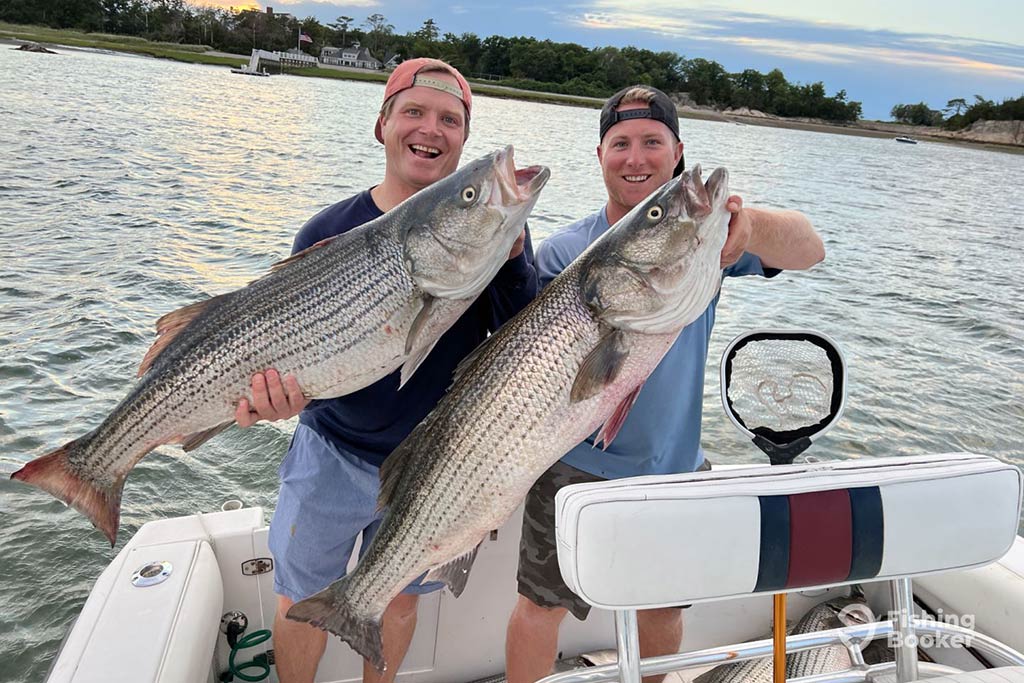
Geographic conditions also played an important role. Massachusetts posted 24 points in Geography, benefiting from a long Atlantic coastline, productive nearshore waters, and easy access to offshore fishing grounds. Anglers’ Interest was more measured, with the state scoring 23.5 out of 55, suggesting that its fishing quality continues to outpace its national visibility.
From Cape Cod to the North Shore, Massachusetts offers highly productive fishing for Striped Bass, Bluefish, Fluke, and Tautog, while offshore waters produce Tuna and Sharks.
9. New York
110 points
For the past two years, New York sat well outside the top 20, making its appearance at 9th place in 2026 one of the more notable shifts in this year’s rankings. That jump wasn’t driven by surging popularity, but by exceptional value and solid access across a wide range of fisheries.
New York stood out financially, posting 53.5 out of 85 points in the Financial category – one of the strongest results nationwide. Reliable infrastructure also played a role, with the state earning 20 out of 40 points in Facilities, supported by extensive marina coverage and launch access across coastal and inland waters.
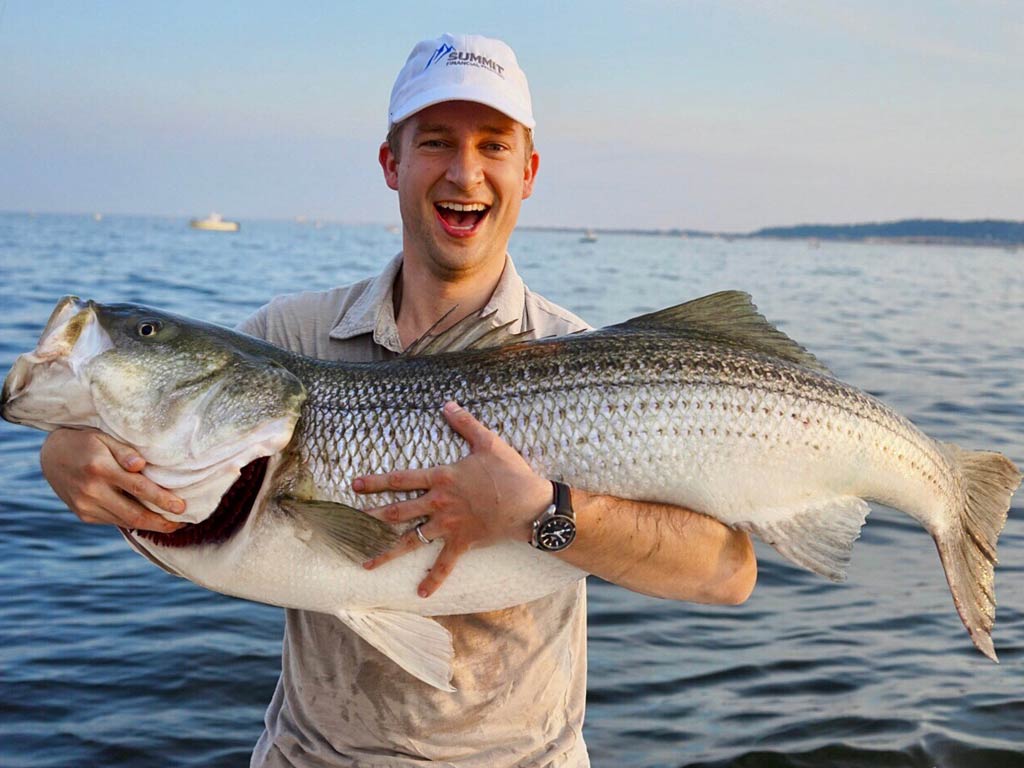
Angler Interest was more restrained, reflected in a 21.5 out of 50 score, while Geography (15 points) captured the state’s dispersed fishing landscape rather than dominance by a single system. Instead of concentrating its strengths in one area, New York spreads them across multiple regions.
That spread is what gives New York its edge. From Striped Bass and Bluefish along the Atlantic coast and Long Island Sound to freshwater fishing in the Great Lakes, Finger Lakes, and Adirondacks, the state offers remarkable variety.
10. Wisconsin
109 points
Freshwater fishing continues to define Wisconsin’s place in the top 10, even though the Badger State slipped from 5th last year to 10th in 2026. With access to Lake Superior to the north and Lake Michigan to the east, along with thousands of inland lakes and rivers, Wisconsin remains one of the most reliable freshwater fishing destinations in the US.
Rather than dominating any single category, Wisconsin once again posted solid, well-balanced results. The state earned 26 out of 55 points in Anglers’ Interest, reflecting steady demand among freshwater anglers. Access and infrastructure remained dependable, with 21 out of 40 points in Facilities, supported by a broad spread of launch sites and charter operations.
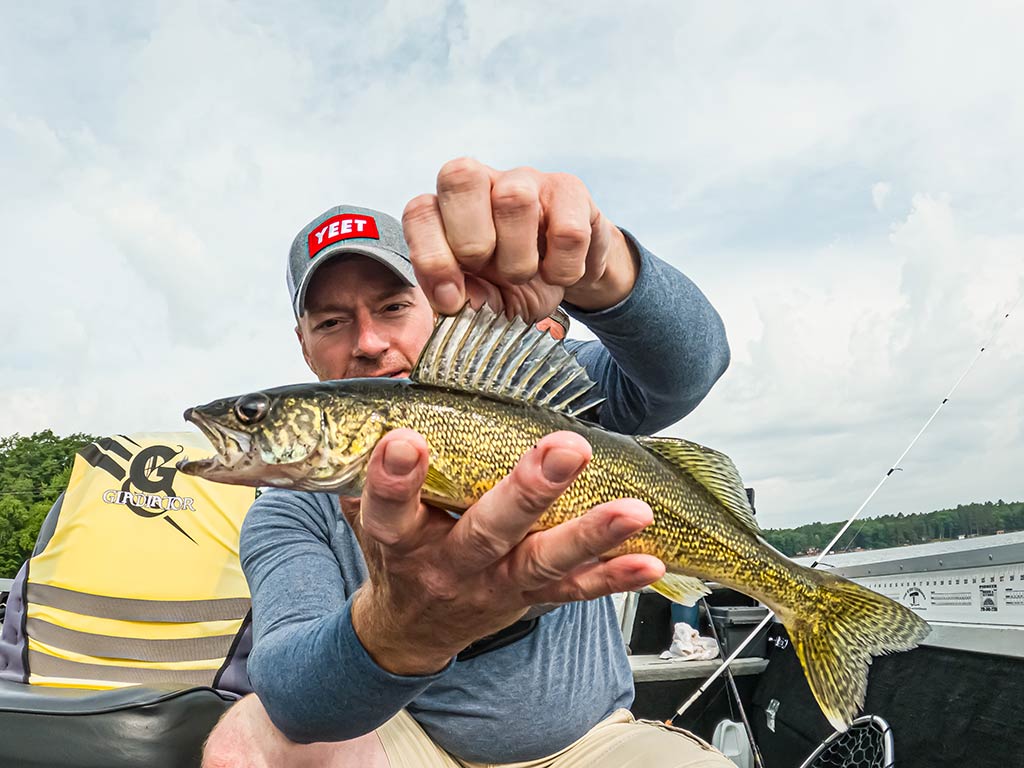
Wisconsin’s strongest numerical showing came in the Financial category, where it scored 45.5 out of 85, reinforcing its reputation as a destination that delivers quality fishing with a reasonable price tag. A Geography score of 16.5 points reflected strong, though less dominant, water coverage compared to some higher-ranked states.
On the water, Wisconsin continues to deliver. Anglers can target Walleye, Trout, Salmon, Northern Pike, Bass, and Perch across the state, with Coho Salmon and Rainbow Trout standing out as favorites. When winter arrives, Wisconsin’s ice fishing scene comes into its own, offering Crappie, Lake Trout, Yellow Perch, and more.
The Full Ranking
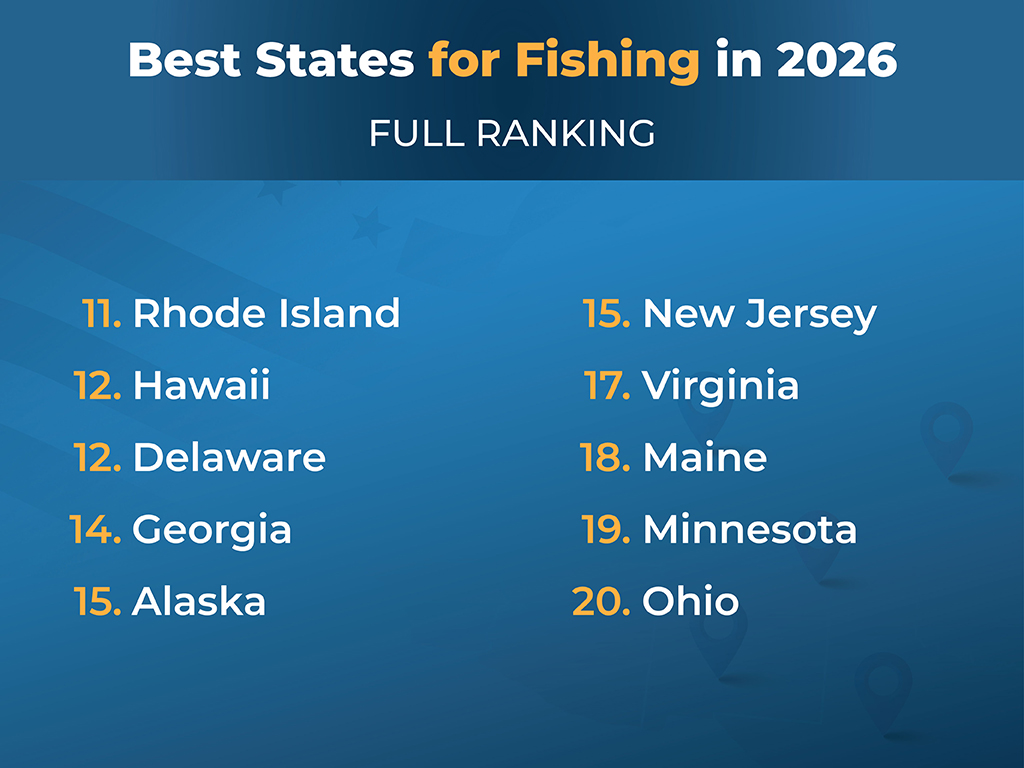
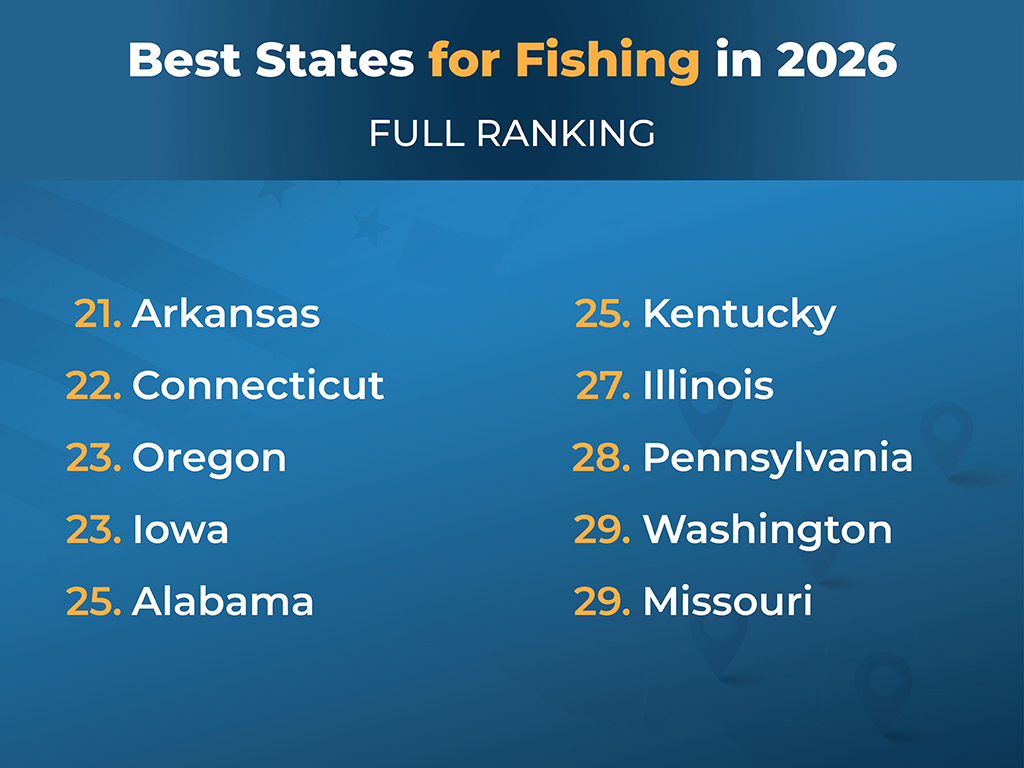
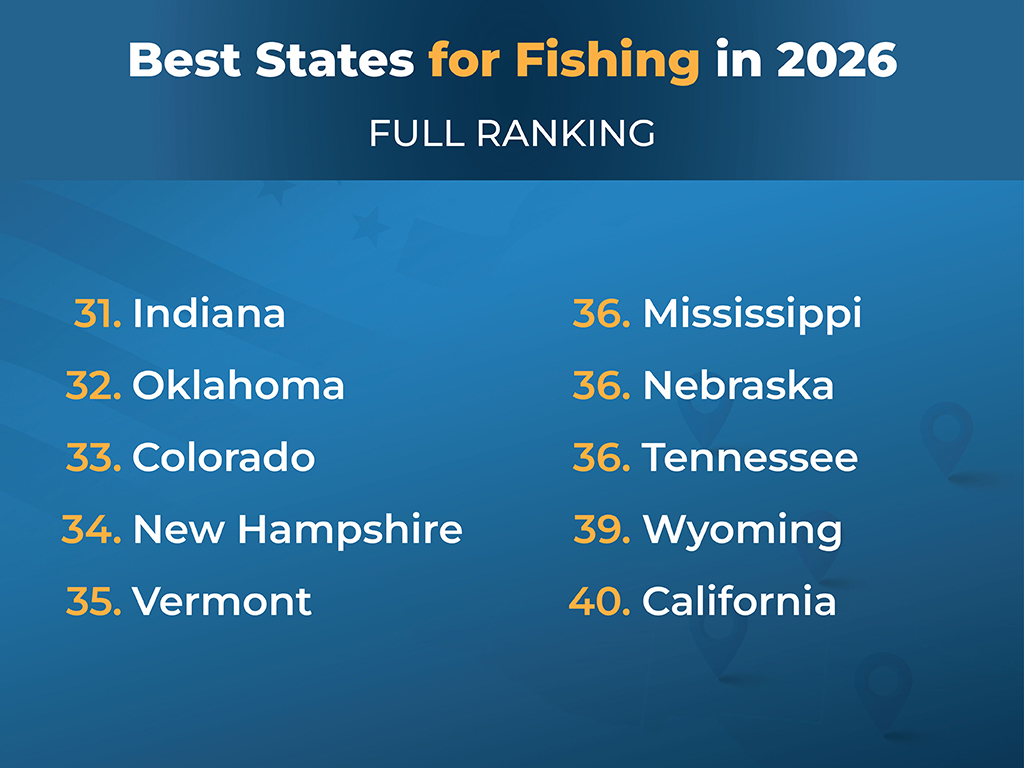
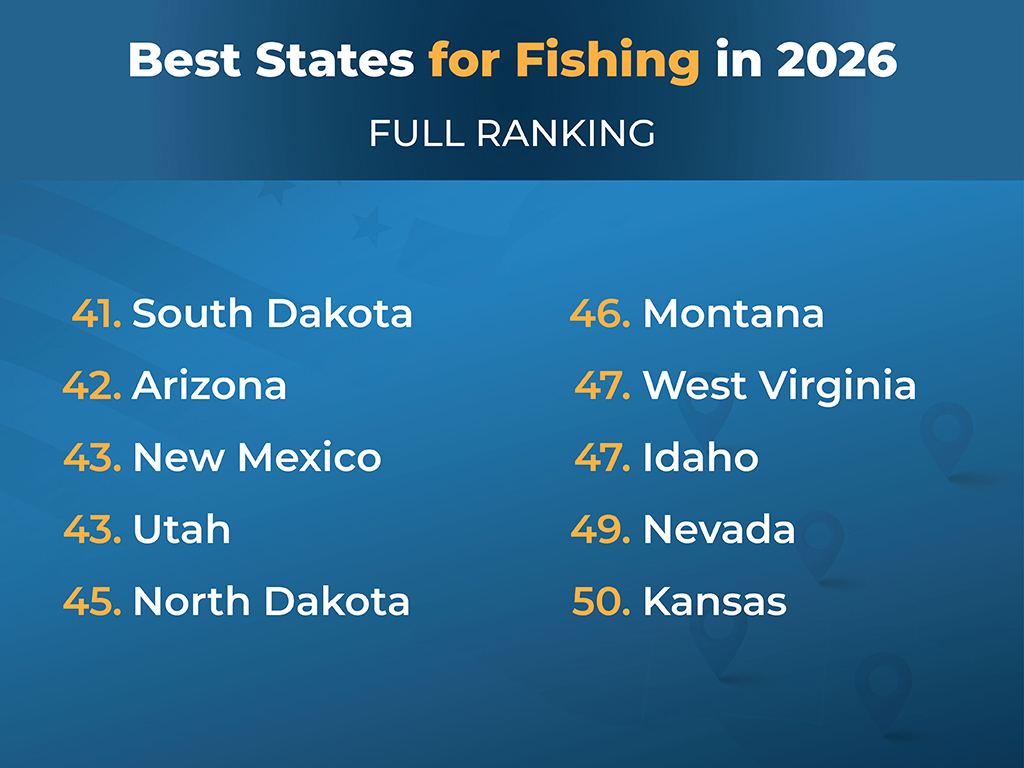
Finding the very best states to fish in the US is no small feat, and a significant amount of research went into this ranking. Now that you’ve got this list to inspire you, which state is your first bucket list destination?
Sources: FishingBooker, National Oceanic and Atmospheric Administration (NOAA), Outdoor Foundation / Recreational Boating and Fishing Foundation, Statista, World Population View, Marinas.com, Bait Shops Near Me, Explore Census Data – Census Bureau, Wikipedia, Hooked in Fishing, American Sportfishing Association, Hey It’s Free, United States Geological Survey (USGS), U.S. Fish & Wildlife Service


