



In this piece, AJ Hauser reflects on his final day on the Green River before moving from Illinois to Arkansas. Fishing with a BFS setup, the plan was simple, but the day carried more weight than expected. As conditions changed and the river offered a few last surprises, the outing became a quiet farewell to a place that had shaped countless hours on the water.
The author does not have any sponsorships. Bait names and brands are mentioned for educational purposes only.
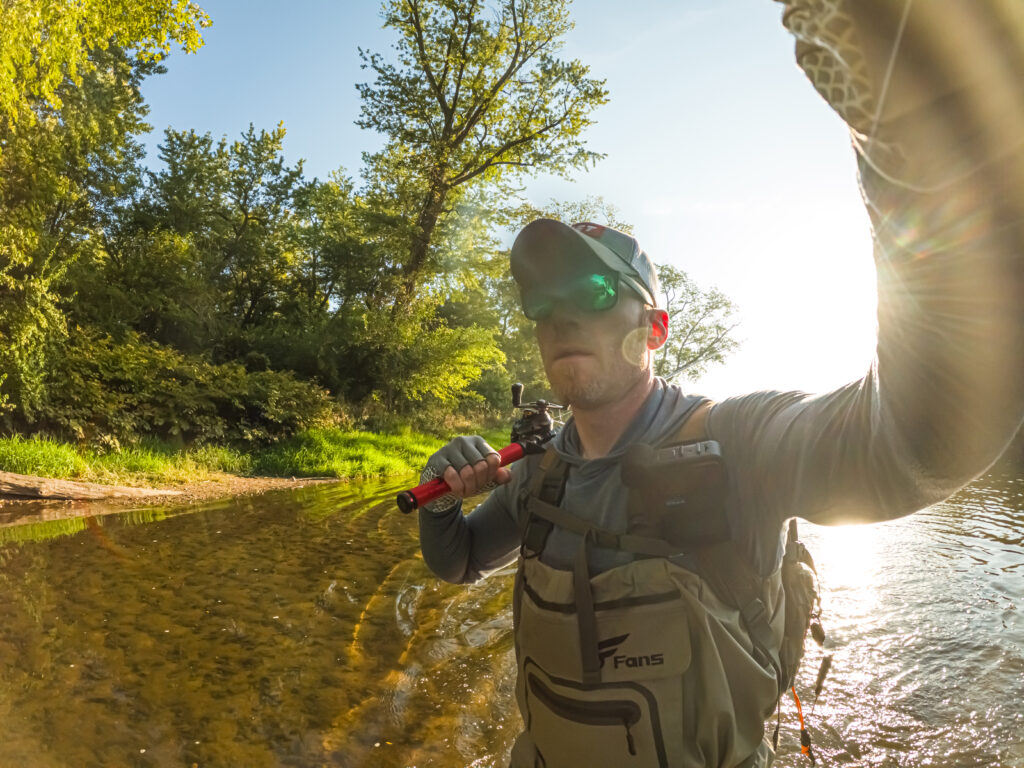
This would be my last visit to the river. Ever. A bittersweet “so long” to a body of water I’ve come to love, but our migration south was already in motion. Today was a goodbye. One last wade before she goes quiet for the season and we pack for Arkansas. Take a few more notes, make a few more casts, then ease off the water like a gentleman.
But The Green River – as she often does – disagreed with my plans. It’s why she’s always had a special place in my fishing portfolio. She’s unpredictable. She likes to zig when everyone else decided to zag. Today she would deliver treacherous new terrain and a handful of unexpected Pike, including a big, strong exclamation point landed on a BFS combo that would send my heart rate through the roof.
This River Is Special
Morning at the highway bridge felt uncommitted. It was as if the day hadn’t made up its mind. The air temp was 57°F and climbing, and a thin harvest haze hung over the treeline. The farmers and their combines had been hard at work in the surrounding fields, and the dust they kicked up drifted in the air like a memory.
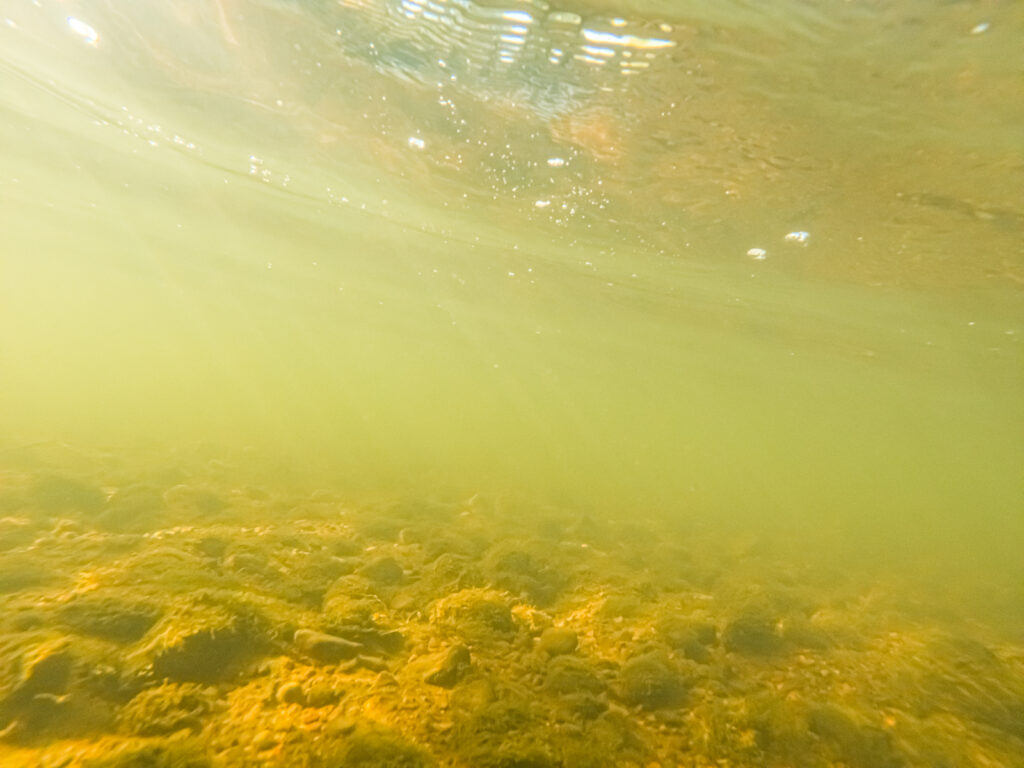
The river itself was clear… by Green River standards. Visibility was decent and the overall water level was low and slow, but a confetti of particles was suspended in the current that never completely rests. Red-winged blackbirds squawked and scolded as I exited the truck. Dry leaves rustled, and nearby raccoons and squirrels scattered off through the brush as I slipped on my waders and laced up my boots, grabbed my gear, climbed down below the bridge, and stepped off the bank. Immediately, I felt the initial rush of cool water pushing past my shins.
The Plan Today Was Simple
Fish what works here. Walk. Cast. Cover water. Repeat.
I would be using a Shimano Curado BFS on a Jenko Double Down casting rod. It worked like a scalpel, meticulously dissecting every piece of cover that I could find. My main line was PowerPro V2 braid (10-pound test), tipped with a 5-foot, 12-pound test monofilament leader – on purpose. That mono would float (unlike fluorocarbon), and a little extra thickness would be useful around the rocks, sticks, and logs, or just in case…
Some anglers obsess over pound test when they fish BFS. I care more about diameter and behavior. The smaller the line, the easier it is to whip weightless baits. This braid has the same diameter as a 2-pound monofilament. That’s tiny, and the 12-pound mono leader buys us extra buoyancy, a bit of stretch, and some forgiveness when things get dramatic.
This is minimalist fishing. A single combo that can work all day for multiple presentations – unless something bites me off.
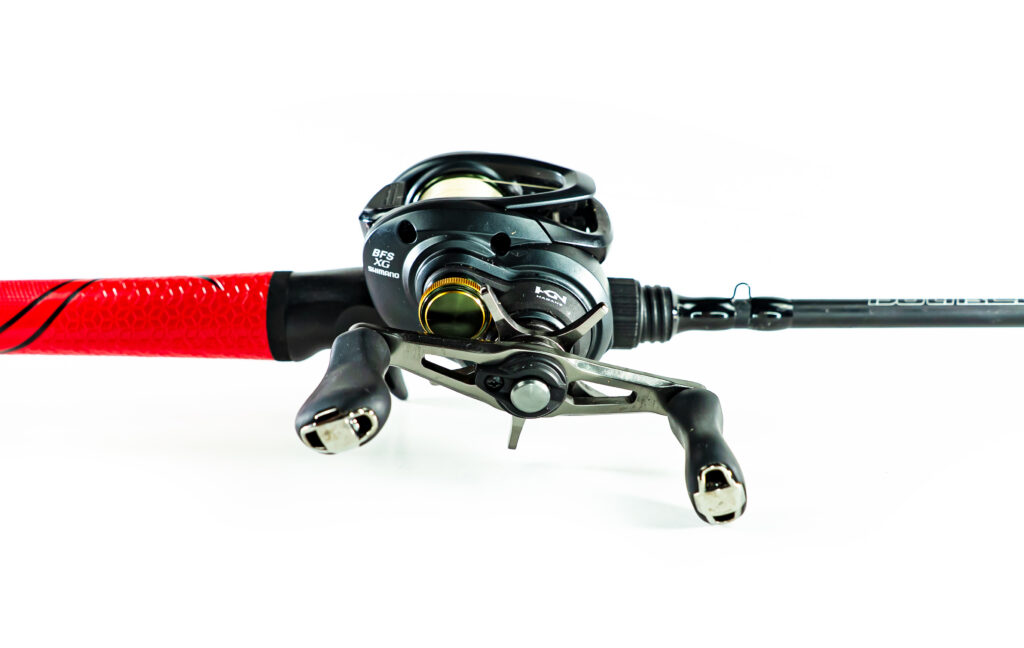
It’s a system that has been refined by the river and other locations. Once BFS gear stopped being “new,” it became a tool in the toolbox. The shallow, light spool that requires low start-up inertia. Minimal tension. Magnetic brakes, fine-tuned to help with line management. Smooth, compact roll casts that land gently on top of targets the size of a nickel. No splash. No spook. No regret. If you’ve read the BFS Beginner’s Guide, you already know the playbook. Today was all about putting it all into practice.
Getting the Bends
The first step this morning was to hike to the first big, deep outside bend. Outside bends can be exceptional fish-holding locations in rivers and streams. As the current whips around corners, it can carve out a deeper, shaded area right in the middle of these horseshoe-shaped spots – sometimes even undercutting the bank itself, sometimes collecting logs, and often giving the fish somewhere to hide, something to relate to, and something to eat.
The first good bend was about half a mile away from the bridge I had crawled beneath to enter the river. It’s a beautiful spot: the current pushes right into a riprap wall, and all along the big bend the bottom is scooped, giving the mean ones a place to hang.
It feels odd at times to walk such a long way without making a single cast, while the rhythmic sloshing and splashing of the water drowns out the surrounding noise. But if you want to be a successful river angler, you don’t need forward-facing sonar. But you do need to understand that not all the water is productive. Making casts along this half-mile stretch might generate a few fish, but bites would likely be scattered and inconsistent at best. Getting to the riprap bend as fast as possible would allow me to fish in a higher-percentage area longer.
The Tunnel Vision Paid Off
Upon arrival, I began casting a Strike King Bitsy Splash (in Tennessee Shad) at the very first stone along the bend. This little topwater does well in the slightly stained river water. The yellow and off-white body isn’t quite as loud as a pure white popper, and the BFS gear was fine-tuned in a way that I was able to “set” my bait right next to the bank without making a large splash or startling any nearby fish.
On the third cast, an ornery Pike exploded out of the water within milliseconds of my popper glugging a wee glug, shattering the morning calm and demolishing the Bitsy bait. “That’s a Pike,” I grunted while setting the hook. “I hope he doesn’t bite me off!” I worked the fish faster than usual, trying to land him quickly so I wouldn’t lose the only off-white bait I had with me.
A quick tug and he was on the bank. I hoisted him for a picture, maybe 22 inches or so. A fun fish for sure, and that strike made my heart race. I needed more. A quick picture, gentle release, and casting resumed.
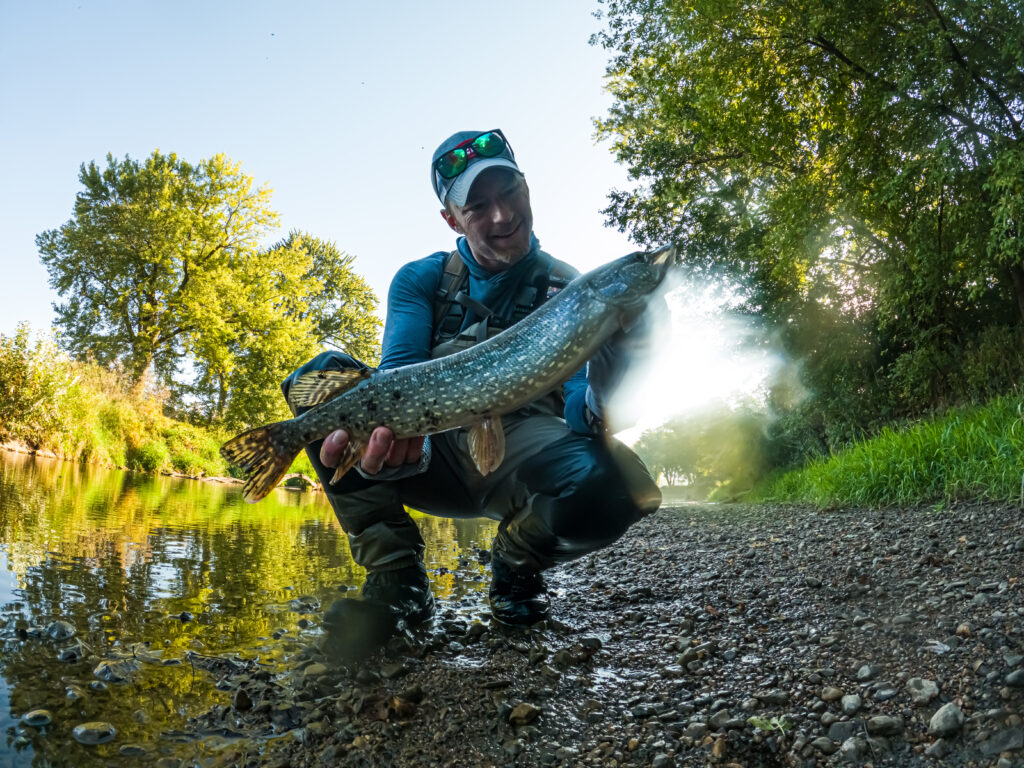
I continued to work my way down and around the riprap bend, placing my popper next to logs, underneath overhangs, right next to little points and cuts in the rocky bank, and the scalpel-like precision was rewarded again and again.
No more Pike – but Smallmouth Bass. Loads of them. One after the next, they crushed the little popper, assuming they’d stumbled upon an easy meal or an unfortunate bug that had fallen from the branches overhanging the river along the shore. One after the next they struck, and one after the next they were landed and released.
The semi-stout hooks on the popper held up well and didn’t bend or break as I used the hemostats attached to my backpack by a retractable cord to grasp and jerk the buried trebles so I could place the fish back in the current as quickly as possible. The monofilament leader held up well, floating right along the skin of the water as the popper made little rings that said “eat me” in plain bass.
Bloop. Pause. Bloop. BOOM!
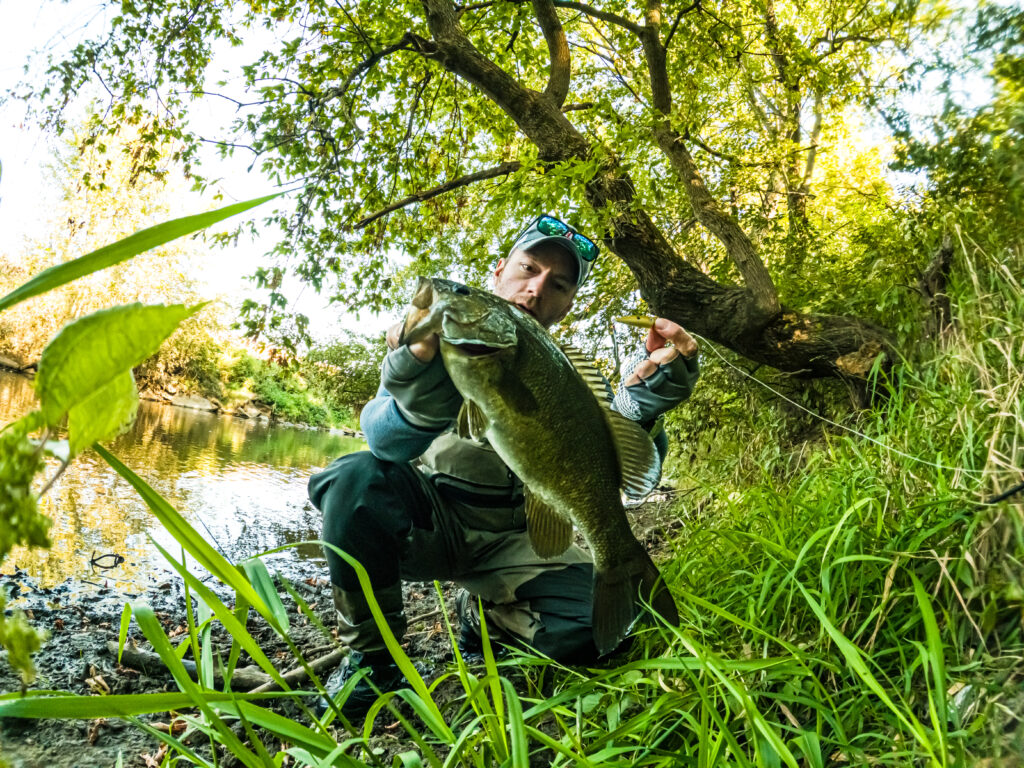
The cycle repeated again and again, consistently… until it didn’t. The Bitsy Splash is a simple little unassuming bait. Almost plain. Inexpensive. But it works unless the topwater bite turns off – and it did. Time to adapt.
A Subsurface Change
My second lure selection was anything but inexpensive or unassuming. The Megabass X-70 jerkbait is a small, 3-inch offering that pairs well with BFS gear, and, at times, it can be brutally effective.
I decided to leave my monofilament leader on instead of retying my knot and swapping in some sinking fluorocarbon. After all, I was only working water 3 to 4 feet deep. The good news was that the mono worked well and caused the jerkbait to slowly, barely rise up as it drifted along in the current.
The bad news? Wind.
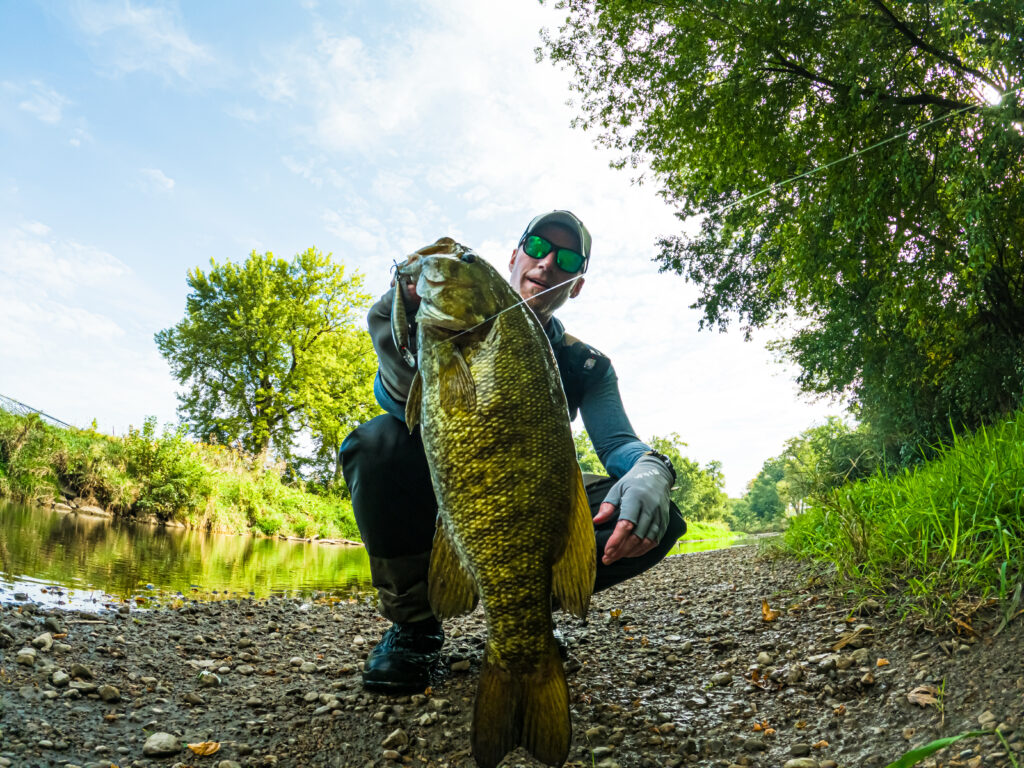
The flat-sided jerkbait caught the wind like a potato chip. I made some adjustments to my BFS gear. Checked the tension on the spool. Tweaked the magnetic brakes. Loosened, then tightened, then loosened again; back and forth and back and forth. I adjusted my cast. Less whippy, slowed down, controlled roll, and lower lure trajectory. In the end, it was functional, and I managed to land 3 decent Smallmouth Bass, but the juice wasn’t worth the squeeze.
After about an hour, I decided to make another two distinct changes. The sun was high in the sky and this year in Illinois, Mother Nature had decided to extend our summer and skip the nice, cool fall weather altogether. I was baking in my waders and needed to find shade. The only way to get it was to hoof another quarter mile through the current. So began the slog. Up ahead, I could see a logjam I had passed several times in the past, when the water was low. Based on the conditions today, it should be passable.
The River’s Reminder
I slipped about halfway across the first big log over water that was just a bit too deep for my liking. The trunk was surprisingly slick, and when I lost control of one boot, the other followed. With a nice big splash, I ended up straddling the log like I was pretending it was a horse.
Thankfully, there was no damage to my bits, and I quickly scanned the area, hoping there were no observers. Only laughing squirrels and chuckling blackbirds. I hoisted myself back to my feet, took a few more careful shuffles forward, and stumbled again! My heel slipped and I pinwheeled down, grasping air, hoping to catch a branch to steady myself… PLOP!
I wasn’t hurt – thankfully – but this was the river’s way of telling me to remember to always respect my surroundings. You are not allowed to be complacent in situations like this, and when it comes time to explore the White River, Buffalo River, or Crooked Creek in Arkansas, I’ll have to watch myself… Slop and pride don’t mix. Noted.
A Deep-Down Delicacy
I made it all the way down to the shady section of the river and decided to make one final change. The topwater bite had cooled, my jerkbait-in-the-wind was frustrating – I needed something sleek that would cast well and cut the water as well as the air, giving me the ability to bomb some casts on my BFS gear…
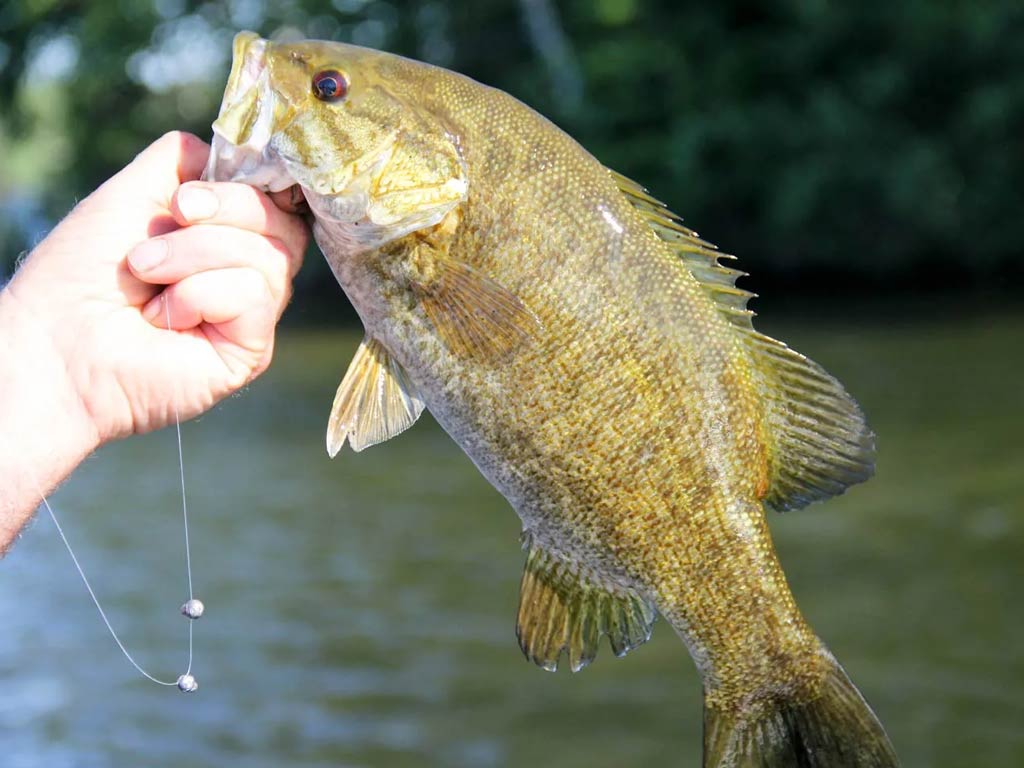
’Ol Faithful: A Z-Man TRD in green pumpkin on a 1/16-ounce head. Perfect in shallow water and slow current. Those outside bends and their underwater troughs are the ideal target for bottom contact. Toss it out. Watch it closely. If the line starts to move more than it should, set the hook. If the line telegraphs tick-ticks as your bait tumbles across the gravel, set the hook. If you move your rod tip and the line feels just a hair heavier than it should, set the hook… It didn’t take long.
Fourteen Smallmouth Bass and another grumpy Pike came to say hello as I worked back and forth along the bend from the cover of my shady canopy. A few hours passed in what seemed like minutes. Reluctantly, I checked my watch: Time to go.
This was it. The last time my boots would push through the current of The Green. “Maybe I’ll be back at some point to fish ’er again,” I told myself, knowing full well that would never come to pass. Slowly, I turned around and started to walk back to the bridge where I began the day, taking step after step at a pace far below the norm.
One More Cast
I was excited to get home to the family, but I wasn’t excited to leave this place. A few steps. Maybe one more cast. A few more… Cast.
The sun beat down on my covered head now as I plodded along outside my shaded honey hole. Green Sunfish took little nibbles on my Ned Rig, and I landed several. The orange tips on their fins stood out vibrantly against their deep green bodies, speckled with tiny bits of blue.
The entire walk was uneventful, but as the bridge came into view, I felt another nibble. WHACK! I set the hook… but my hook didn’t move. “Is that another Pike?! Oh my gosh, look at the size of that fish!”
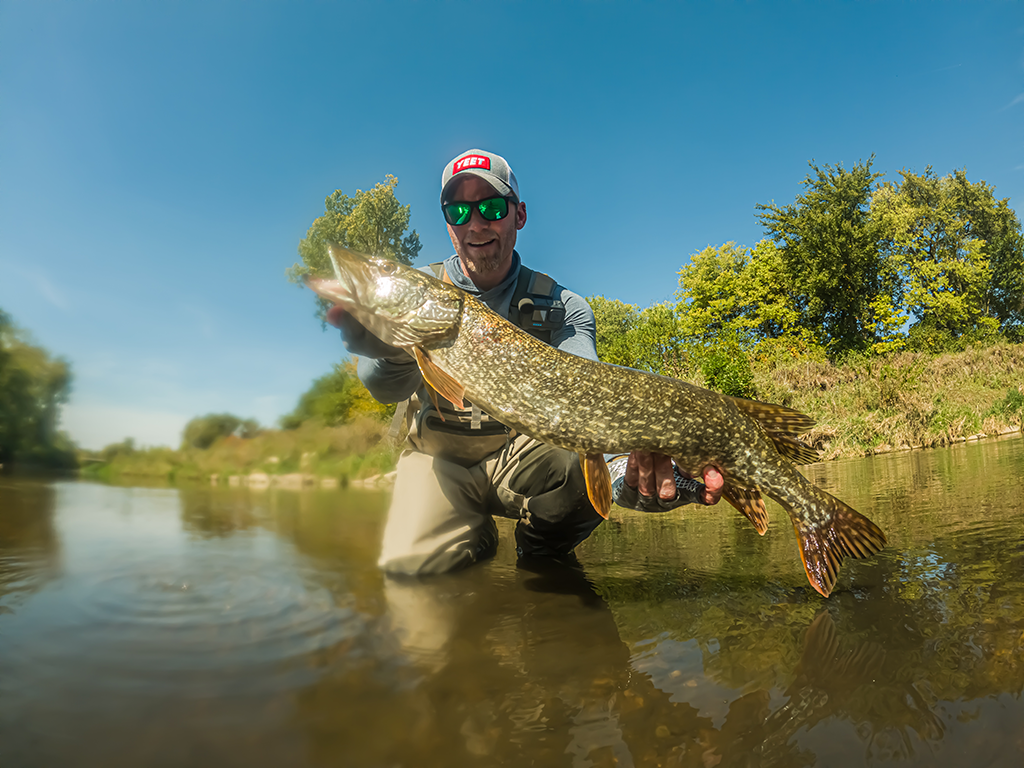
The sun flashed off the side of a strong, silvery iridescent body. Drag clicked loudly as she made a powerful run. Fish that live in the current are good for testing your equipment. After a few good tugs, I turned her back toward me. The biggest Pike I’d ever seen in this river was hooked by a tiny little jig tied to 12-pound test monofilament on a BFS combo. Surely the leader stood no chance against those gnashing, razor-sharp teeth… and yet… it held.
I waded out to meet the fish in the middle of the river, hoping I could quickly grasp her back, right behind the head. No net was available, so we’d have to land her the old-fashioned way. She ran; I laughed; She ran again. The spine of the Double Down rod bent over completely, like an old flip phone. But, Lord, this was so much better than looking at some screen or drooling over a device!
In one quick motion, I slid my hand down the line and firmly grasped the fish. Cold, slimed muscle spasmed and swayed – but it was too late now – she knew it too, and went still. We moved toward the shore. My little Ned Rig sat perched ever so perfectly right in the corner of her mouth. The body of the jig kept my mono leader just outside the reach of those glistening teeth.
It took nothing more than a quick flick to free her, and as I hoisted her high by the gill to inspect and admire, her right eye seemed to stare back. The size of a quarter and golden-yellow. Cold. Steady. How many fish had seen this amber circle a split-second before meeting their ultimate demise?
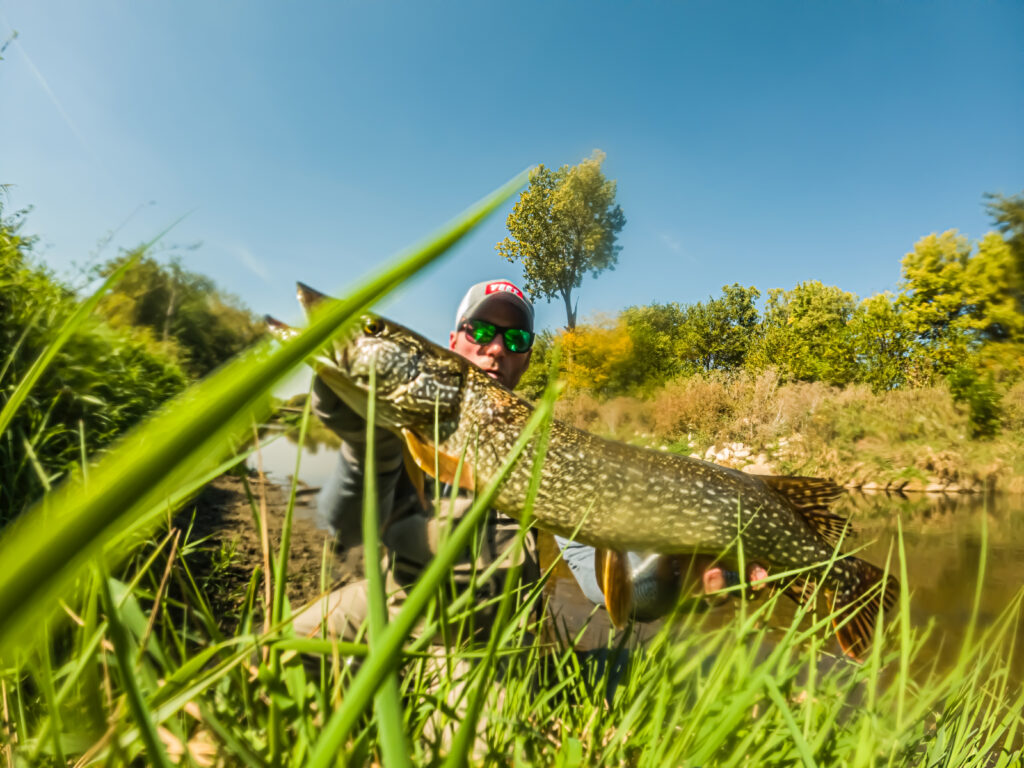
She was 30 inches if I pinched the tail. Not a huge Pike by any means, but huge for the Green River. A trophy. We took a quick pic together, and she was released. I watched her swim slowly back to the deep, shady trench on the opposite side of the river… She was gone, and my wade was over.
The truth was that I had never caught a Pike in this river before today. Sure, I’d heard the stories, seen the pictures. Heck, I’d seen them too – a quick flash and they’d be gone (with my bait in their mouth) – but today, on my final jaunt in The Green, everyone decided to play nice.
Out of the Current
Back at the bridge, I made my way up the muddy, dirty shoreline. Through the tall, wispy grass and out into the clearing where my bright red truck sat in the scorching sun. I peeled the sopping wet boots and waders off. Everything squished and squashed: I’d sprung a leak… No matter. The season was over. My time in Illinois was over as well.
In my mind, the thought of exploring those Arkansas waterways filled me with excitement, but before I hopped in the truck, I turned back and took one last look at The Green. She was good to me today. Maybe better than she’d ever been. It was time to go.
Farewells are supposed to be quiet. This one wasn’t, but what a way to put my final signature on this incredible place. Here’s to the next adventure. Tight Lines and Godspeed, Patriots!
