Swordfish Fishing
The best out of 652 Swordfish Fishing deals - enter destination and dates to check availability
Nearest Swordfish fishing charters
- Trips fromUS $2,500

- Instant ConfirmationTrips fromUS $1,400
- Instant ConfirmationTrips fromUS $2,600
- Trips fromUS $2,800
- Instant ConfirmationTrips fromUS $2,000
- Instant ConfirmationTrips fromUS $3,150
BAM Adventures LLC – 52'
Bethany Beach, DelawareInstant ConfirmationTrips fromUS $3,800- Instant ConfirmationTrips fromUS $3,400
- Trips fromUS $3,850
- Angler's ChoiceTrips fromUS $850
Fresh Swordfish fishing catches
Featured Swordfish fishing charters
- 10 Hour Trip – Night Swordfish
Spend the night drifting for Swordfish on this exciting 8-10-hour trip. You'll be supplied with top-notch Shimano gear, just note that a 15-20% gratuity is expected. Departure time is completely flexible.Instant ConfirmationPrice for up to 6 peopleUS $2,500 - 6 hr sunset fishing trip



+7The afternoon bite is very hot this time of the year especially for Blackfin Tunas and other species like mahi Kingfish Wahoo and sailfish. If you have any special requests please give us a call after booking to go over any detailsPrice for up to 5 peopleUS $750 - Angler's Choice10 Hour Trip – Daytime Swordfish


+1The true meaning of deep sea fishing, head 20 miles offshore to the Gulf Stream in search of the Broadbill Swordfish, fishing depths up to 2,000 feet of water. Swordfish is the target species, but other catches could include Mahi Mahi, Tuna, and Wahoo.Price for up to 6 peopleUS $1,800 - Angler's ChoiceUltimate Big Game Swordfish!


+3Miami is the Swordfish capital of the World. The Florida record is 757lbs, with the average fish being over 150lbs. This is a long-range trip for serious anglers as we will be 20 miles offshore fishing the bottom in 1800' deep! This is a 10hr trip due to the distance we have to travel. The trip is combo'd with Rock Snapper on the way in and of course we always have Mahi/Tuna bait out while swordfishing. Swords are also great eating! Mount services available. $50 cleaning fee-Sword. $3/each RS, Mahi, TunaInstant ConfirmationPrice for up to 6 peopleUS $1,600 - 8 Hour TripThis trip will take you further offshore, outside of the bay, to target a wider range of species. Your bucket list consists of Sailfish, Swordfish, Blue Marlin, Mahi Mahi, Cubera Snapper, Skipjack, and more. Rods, reels, tackle, and licenses are included. Beer, soda, and water will be provided, so just bring your own snacks and be sure to pack sunglasses, a hat, and sunscreen.Price for up to 6 peopleUS $763
- Angler's Choice10 hr swordfish


10hr swordfish tripInstant ConfirmationPrice for up to 6 peopleUS $1,700 - Angler's Choice10 Hour Trip — Swordfish (2 PL MAX)
—>DO NOT BOOK WITHOUT CONTACTING THE CAPTAIN FIRST! Please send an inquiry.<— This trip focuses on swordfish using electric reels. Maximum of 2 passengers. Widely considered the pinnacle of sportfishing. Please contact the captain before booking.Price for up to 2 peopleUS $1,995 - Angler's ChoiceHalf Day Trip – All Inclusive


+8The company of Cabo Sportfishing prides itself on being a first-class team of captains that provide top-quality service and equipment. Get ready to spend an exciting and action-packed day of fishing with an English-speaking crew that always puts the customers first, and will go out of their way to put you on fish! Your main targets are Marlin, Tuna, Mahi Mahi, Wahoo, Sailfish, and Roosterfish, just to name a few. This trip includes licenses, tackle, and everything else you may need for an awesome day.Instant ConfirmationPrice for up to 4 peopleUS $625 - 8 hour fishing trip


+8Our Full Day trip is an overall experience providing time to adjust to the areas and conditons. So we can fish efficiently and effectively throughout the day. On the trip we can do multiple of different techniques of fishing or if you just wanted a target one kind of species of fish.That means more time spending doing each technique or just a better chance of catching that one fish of your dreams.Instant ConfirmationPrice for up to 6 peopleUS $1,900 - Supreme Full Day Trip


+612 HoursInstant ConfirmationPrice for up to 4 peopleUS $1,850
What anglers say about Swordfish fishing
- 5.0/5(Half day trip ,5 hours .)
Erstes Mal Hochseefischen mit Sohn und Enkelkinder
Es war ein super Tag an Bord. Das erste Mal Hochseefischen für die Kinder. Alle waren super freundlich und das Fangerlebnis war auch absolut spitze.
- 5.0/5(Full Day Swordfish Trip)
God Tier Fishing
Captain David and Andy couldn’t have been any better. They put us in fish immediately, catching 40+ Fish! Great Time with Great People!!!!
- 5.0/5(12 Hour Trip - Deep Sea Fishing)
Great Trip!
2/23/2026 Captain and First Mate Chris were great. Worked incredibly hard to put me on fish but also fun to be around. Caught Black Fin Tuna, Wahoo, Barricuda, Rainbow Runners and to cap it off a nice Sword Fish! I highly recommend fishing with this crew.
- 5.0/5(10 Hour Trip – Daytime Swordfish)
absolute sea monster!!
We went out with Captain Vinny for the second year in a row and it did not dissapoint! we got an absolute sea monster of a swordfish near 300 lbs!
- 5.0/5(10 Hour Trip – Daytime Swordfish)
Unforgetable trip!!
Captain Pete is the real deal! We had an unforgettable trip and brought in both sailfish and mahi-mahi thanks to his nonstop effort and expertise. He worked incredibly hard all day, adjusting baits, watching conditions, and putting us right where the fish were. If you want a captain who truly cares about getting you on the bite, Captain Pete is your guy. Highly recommend!
About Swordfish fishing
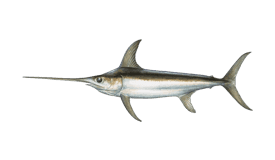
The blazing fast, flat-billed Swordfish are considered by many anglers to be the ultimate big game challenge. They are vicious fighters with a weapon to match and be wary of, as their frantic head shakes and attempts at impaling don't stop until the very last second.
The Swordfish is an often overlooked billfish, being relatively hard to find during standard charter trips and caught mostly commercially by longline or harpoon at great offshore distances and depths. However, the species offers a true test of angling prowess, as landing one on hook and line requires excellent bait presentation, great technique and strength and a fair share of luck.
An interesting fact about Swordfish is that they have specially evolved tissue masses connected to their eye muscles that provide heat retention and insulation of the eyes and brain. This improves their already sharp vision and allows venturing to greater depths and geographical latitudes. Due to this, Swordfish can commonly be found in almost subpolar waters and in depths of around 1800ft, and, extremely, up to 9500ft.
How big
The largest caught Swordfish came in at a whopping 14.9ft and 1430lbs, but catches average mostly between 4 and 6ft and about 100lbs. The largest fish can be found in the Pacific, followed by western Atlantic catches and Mediterranean fish as the smallest. Most Swordfish over 200lbs will be females.
When & Where
Swordfish can be found throughout the the Atlantic, Indian and Pacific Oceans. They move in an extended latitudinal range of 60°N to 45°S due to their ability to preserve brain heat, which makes them able to withstand a wider range of temperatures.
As most highly migratory species though, they move to warmer waters during winter to spawn. Reproduction, thus, happens year-round in equatorial waters and seasonally during spring and summer in cooler tropical and subtropical seas.

Team effort gets the job done. Caught by Blackwater Charters out of Islamorada, FL
How to catch
Swordfish are tricky to catch. In productive grounds they can often be seen at the surface during the day, but might not want to take any bait if they're not feeding at the time. They generally eat more after dark, with night fishing being more difficult, especially with fish as dangerous as this one. The alternative is drifting bait as far down as 2000ft for the large depth-dwelling individuals.
Bait should be natural and can be small like mullet, herring or squid or larger like Bonito, Little Tunny, Cero or Spanish Mackerel. Concrete sinkers up to 10lbs serve to drop the bait as far down as needed. Various squid and fish imitations can be used too, with specialized swordfishing lures being equipped with glowing lights. Deep jigging is known to be successful.
Some anglers spearfish for surface-swimming Swordfish, but there have been reports of gruesome outcomes, as wounded Swordfish are erratic and irritated. They are also known to make fierceful dives towards the bottom, at times penetrating the sandy ocean floor up to their eyes.
In addition to having a sharp, flat, bill that can easily dispose of your line or cause harm, Swordfish also pull extremely hard and fast, perform aerial leaps trying to shake the hook off and - have a notoriously soft mouth that can easily tear. This is why a heavy and braided line at least a mile long, a fighting chair, an experienced guide to handle the fish once reeled in and a lot of luck are prerequisites for Swordfishing.
Good to eat?
The meat is delicious and as firm as steak, so can be prepared in many different ways. However, high levels of mercury have been reported in specimens.
Regulations
USA*:
- Season - always open;
- Size limit (minimum) - Florida, South Carolina - 47'' LJFL; Louisiana - 29'' CL; other states have no size regulations;
- Bag limit - Florida - 1 per harvester per day (not to exceed a maximum of 4 per not for-hire vessel or 15 per for-hire vessel per day); South Carolina - 1 per harvester per day (not to exceed a maximum of 4 per vessel per day); Louisiana - up to 5 per vessel per trip; California - 2; other states have no bag regulations;
* Federal rules apply in most states. Landing an Atlantic Highly Migratory Species requires having a valid licence and reporting to NOAA within 24h at 800-894-5528 or hmspermits.noaa.gov;
- Season - always open;
- Western Australia, New South Wales and Victoria - up to 1 fish, no size limits;
- Queensland, South Australia - no regulations;
Habitats
The blazing fast, flat-billed Swordfish are considered by many anglers to be the ultimate big game challenge. They are vicious fighters with a weapon to match and be wary of, as their frantic head shakes and attempts at impaling don't stop until the very last second.
The Swordfish is an often overlooked billfish, being relatively hard to find during standard charter trips and caught mostly commercially by longline or harpoon at great offshore distances and depths. However, the species offers a true test of angling prowess, as landing one on hook and line requires excellent bait presentation, great technique and strength and a fair share of luck.
An interesting fact about Swordfish is that they have specially evolved tissue masses connected to their eye muscles that provide heat retention and insulation of the eyes and brain. This improves their already sharp vision and allows venturing to greater depths and geographical latitudes. Due to this, Swordfish can commonly be found in almost subpolar waters and in depths of around 1800ft, and, extremely, up to 9500ft.
How big
The largest caught Swordfish came in at a whopping 14.9ft and 1430lbs, but catches average mostly between 4 and 6ft and about 100lbs. The largest fish can be found in the Pacific, followed by western Atlantic catches and Mediterranean fish as the smallest. Most Swordfish over 200lbs will be females.
When & Where
Swordfish can be found throughout the the Atlantic, Indian and Pacific Oceans. They move in an extended latitudinal range of 60°N to 45°S due to their ability to preserve brain heat, which makes them able to withstand a wider range of temperatures.
As most highly migratory species though, they move to warmer waters during winter to spawn. Reproduction, thus, happens year-round in equatorial waters and seasonally during spring and summer in cooler tropical and subtropical seas.

Team effort gets the job done. Caught by Blackwater Charters out of Islamorada, FL
How to catch
Swordfish are tricky to catch. In productive grounds they can often be seen at the surface during the day, but might not want to take any bait if they're not feeding at the time. They generally eat more after dark, with night fishing being more difficult, especially with fish as dangerous as this one. The alternative is drifting bait as far down as 2000ft for the large depth-dwelling individuals.
Bait should be natural and can be small like mullet, herring or squid or larger like Bonito, Little Tunny, Cero or Spanish Mackerel. Concrete sinkers up to 10lbs serve to drop the bait as far down as needed. Various squid and fish imitations can be used too, with specialized swordfishing lures being equipped with glowing lights. Deep jigging is known to be successful.
Some anglers spearfish for surface-swimming Swordfish, but there have been reports of gruesome outcomes, as wounded Swordfish are erratic and irritated. They are also known to make fierceful dives towards the bottom, at times penetrating the sandy ocean floor up to their eyes.
In addition to having a sharp, flat, bill that can easily dispose of your line or cause harm, Swordfish also pull extremely hard and fast, perform aerial leaps trying to shake the hook off and - have a notoriously soft mouth that can easily tear. This is why a heavy and braided line at least a mile long, a fighting chair, an experienced guide to handle the fish once reeled in and a lot of luck are prerequisites for Swordfishing.
Good to eat?
The meat is delicious and as firm as steak, so can be prepared in many different ways. However, high levels of mercury have been reported in specimens.
Regulations
USA*:
- Season - always open;
- Size limit (minimum) - Florida, South Carolina - 47'' LJFL; Louisiana - 29'' CL; other states have no size regulations;
- Bag limit - Florida - 1 per harvester per day (not to exceed a maximum of 4 per not for-hire vessel or 15 per for-hire vessel per day); South Carolina - 1 per harvester per day (not to exceed a maximum of 4 per vessel per day); Louisiana - up to 5 per vessel per trip; California - 2; other states have no bag regulations;
* Federal rules apply in most states. Landing an Atlantic Highly Migratory Species requires having a valid licence and reporting to NOAA within 24h at 800-894-5528 or hmspermits.noaa.gov;
- Season - always open;
- Western Australia, New South Wales and Victoria - up to 1 fish, no size limits;
- Queensland, South Australia - no regulations;