Hero Banner
Hero Banner

Ribolov Amberjack

Najbolje od 2603 Amberjack ribolovnih ponuda - unesite destinaciju i datume da proverite dostupnost

Najbliži ribolovni čarteri za ribolov Amberjack

Čarteri
Listing image
21 ft
Up to 3 persons
Neposredna potvrda
Ture od
US $300
Listing image
43 ft
Up to 6 persons
Neposredna potvrda
Ture od
US $900
Listing image
55 ft
Up to 6 persons
Listing image
34 ft
Up to 6 persons
Novo
Ture od
US $1,150
Listing image
42 ft
Up to 6 persons
Neposredna potvrda
Ture od
US $1,400
Listing image
20 ft
Up to 3 persons
Novo
Neposredna potvrda
Ture od
US $650
Listing image
30 ft
Up to 6 persons
Neposredna potvrda
Ture od
US $1,700
Listing image
36 ft
Up to 6 persons
Neposredna potvrda
Ture od
US $1,950
Listing image
32 ft
Up to 6 persons
Neposredna potvrda
Ture od
US $1,725
Listing image
45 ft
Up to 6 persons

Najbliži ribolovni čarteri za ribolov Amberjack

Sveži ulovi Amberjack

Šta ribolovci kažu o Amberjack ribolovu

  • 5.0
    /5
    (6 Hour Trip)

    Constant action and entertainment!

    We instantly picked up on how knowledgeable the captin as well as the first mate. They made a perfect team and continued to bounce ideas off of each other to locate and catch fish. 10/10 recommend.
    Drew T.
    Drew T.
    Reviewed on Aug 28, 2026
  • 5.0
    /5
    (Shared Trip)

    First offshore Trip was a success!

    Captain Ben made sure everything was accounted for and got us on some pretty amazing fish. Highly recommend to others!
    Andrew K.
    Andrew K.
    Reviewed on Aug 28, 2026
  • 5.0
    /5
    (6 hours Tuna)

    super angeltag

    marc war ein super capitain , auch wenn ew mit den grossen tunfischen leider nicjt geklappt har , hat er sich mega viel muhe gegeben und wir haben etliche andere fische gefangen
    Markus S.
    Markus S.
    Reviewed on Aug 27, 2026
  • 5.0
    /5
    (8 Hour Trip - Bottom Fishing)

    many many fish on board

    The Stevi (both capt and 1st mate are Steven) took us straight to fish. by the time our first weight hit the bottom we were already fish on and just kept coming from there. Plenty of Red Snapper. we wanted a fight so he took us to catch some bait fish, then the fight was on with the Amberjacks. despite a dolphin deciding to play with one of them, we had some great fights and great catches. the Stevi were super attentive and helpful.
    Andrew S.
    Andrew S.
    Reviewed on Aug 27, 2026
  • 5.0
    /5
    (8 Hour Trip (Offshore))

    I'll be back!

    John and Rick were like a well oiled machine the way they worked together to make my fishing trip an absolute blast. We were on the fish from the jump. And I thought for a second that I made the captain mad, when I suggested I would bait my hook :) I had a great day out on the water with these "two" captains! I will be back.
    Tony G.
    Tony G.
    Reviewed on Aug 26, 2026

O Amberjack ribolovu

Veličina
20 to 40lbs
Vrednost hrane
Prosek
Game Quality
Dobro

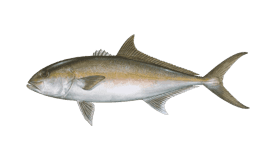
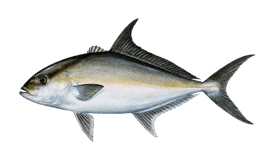
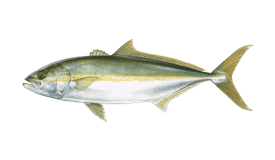
Amberjacks are the largest fish of the Carrangidae family (which includes Jacks and Trevallies) and are widely targeted for their hard fighting game qualities. Big and powerful, these fish strike fast, pull hard and do deep and forceful dives to the bottom.

This species mostly inhabits reefs and wrecks from 60 to 240ft deep, but can often be found around floating objects and near the surface. Amberjacks have been caught inshore in Florida as well. Young ones move in schools, but older fish are mostly loners.

How big

Amberjacks have an elongated body that can grow to about 6ft and 160lbs. The average catch will be between 20 and 40lbs though, but, depending on where and when you target them, larger fish can be a commodity. They live around 17 years and mature at 4-5.

Three men holding up a huge Amberjack on a boat on the open sea

Catching a small Amberjack is a challenge. One that the crew of Elias II out of Cape Verde can't seem to accept

When & Where

This species can be found in tropical and warm temperate waters worldwide, including: the Indo-Pacific - around Madagascar, in the Persian Gulf, around south Japan (where the record fish was recently caught), China and the Philippines; around Hawaii; in the western Atlantic from Nova Scotia to Brazil, including the Gulf of Mexico, Bermuda and the Caribbean Sea; in the eastern Atlantic from the British isles to Morocco and in parts of the Mediterranean Sea, but also off southern and western Africa. They're replaced by Yellowtail Amberjacks off Australia and California.

The warmer the waters, the more AJs around, with Miami and the Keys being perfectly positioned to be a year-round fishery in the USA. Fishing farther up north along the Atlantic coast and the Gulf coast will be the most productive early spring through the end of May.

How to catch

Amberjacks are opportunistic feeders that will go for most any type of bait (live, dead, strip, plugs, jigs, spoons, flies) as long as it's presented well.

If located around deep reefs, dropping down some speedo mackerel (or other bigger live baitfish) in approach from the downcurrent side will work great, as will deep vertical jigging coming from the upcurrent side - change the depth frequently until a strike occurs.

If you want to get the fish closer to the surface, you should tease them with live bait tied to a line with no hook. When they come up, either fast trolling or using large, noisy, poppers or surface plugs will get you a bite.

Two people holding up a big Amberjack on a boat on the open sea

This is a regular reef donkey right here.


Amberjacks usually hook themselves, so setting the hook is mostly not necessary. Once they've got the bait, you should allow the initial run, but as soon as it's over, they will make a dash for the bottom, where the line can easily get cut on the structure. When boated, it's common that other Amberjacks follow up.

Good to eat?

Lean, firm and white meat with mild taste. However, Amberjacks are highly ranked among tropical fish species known to cause ciguatera (fish poisoning). Bigger fish should be released as a precaution.
Regulations

Season - Gulf waters - closed June 1 - July 31; Atlantic waters - open year-round;
 
Size limit (minimum) - Gulf state waters - 34'' FL, except 30''FL for Mississippi; Atlantic state waters - 28'' FL, except 32'' for Virginia;
 
Bag limit (per angler per day) - 2 for Virginia, 1 for all other states;
 

Amberjacks are the largest fish of the Carrangidae family (which includes Jacks and Trevallies) and are widely targeted for their hard fighting game qualities. Big and powerful, these fish strike fast, pull hard and do deep and forceful dives to the bottom.

This species mostly inhabits reefs and wrecks from 60 to 240ft deep, but can often be found around floating objects and near the surface. Amberjacks have been caught inshore in Florida as well. Young ones move in schools, but older fish are mostly loners.

How big

Amberjacks have an elongated body that can grow to about 6ft and 160lbs. The average catch will be between 20 and 40lbs though, but, depending on where and when you target them, larger fish can be a commodity. They live around 17 years and mature at 4-5.

Three men holding up a huge Amberjack on a boat on the open sea

Catching a small Amberjack is a challenge. One that the crew of Elias II out of Cape Verde can't seem to accept

When & Where

This species can be found in tropical and warm temperate waters worldwide, including: the Indo-Pacific - around Madagascar, in the Persian Gulf, around south Japan (where the record fish was recently caught), China and the Philippines; around Hawaii; in the western Atlantic from Nova Scotia to Brazil, including the Gulf of Mexico, Bermuda and the Caribbean Sea; in the eastern Atlantic from the British isles to Morocco and in parts of the Mediterranean Sea, but also off southern and western Africa. They're replaced by Yellowtail Amberjacks off Australia and California.

The warmer the waters, the more AJs around, with Miami and the Keys being perfectly positioned to be a year-round fishery in the USA. Fishing farther up north along the Atlantic coast and the Gulf coast will be the most productive early spring through the end of May.

How to catch

Amberjacks are opportunistic feeders that will go for most any type of bait (live, dead, strip, plugs, jigs, spoons, flies) as long as it's presented well.

If located around deep reefs, dropping down some speedo mackerel (or other bigger live baitfish) in approach from the downcurrent side will work great, as will deep vertical jigging coming from the upcurrent side - change the depth frequently until a strike occurs.

If you want to get the fish closer to the surface, you should tease them with live bait tied to a line with no hook. When they come up, either fast trolling or using large, noisy, poppers or surface plugs will get you a bite.

Two people holding up a big Amberjack on a boat on the open sea

This is a regular reef donkey right here.


Amberjacks usually hook themselves, so setting the hook is mostly not necessary. Once they've got the bait, you should allow the initial run, but as soon as it's over, they will make a dash for the bottom, where the line can easily get cut on the structure. When boated, it's common that other Amberjacks follow up.

Good to eat?

Lean, firm and white meat with mild taste. However, Amberjacks are highly ranked among tropical fish species known to cause ciguatera (fish poisoning). Bigger fish should be released as a precaution.
Regulations

Season - Gulf waters - closed June 1 - July 31; Atlantic waters - open year-round;
 
Size limit (minimum) - Gulf state waters - 34'' FL, except 30''FL for Mississippi; Atlantic state waters - 28'' FL, except 32'' for Virginia;
 
Bag limit (per angler per day) - 2 for Virginia, 1 for all other states;